Lessons learned from using a personal AI call assistant

Why?
A few months ago, on social media I saw several posts about creating a personal AI call assistant that receives calls and has conversations with a callers. Afterwards, a summary of the call is sent to the owner of the phone number.
This sounded like a great idea to me. If I can’t pick up the call, then my personal AI assistant will ask for the details and send me a summary over Internet communicator. I would know who had called me and why!
I decided to give it a try and see how it could work in practice.
How?
To create a personal AI assistant we need to combine a few services:
1. Twilio – allows to create a phone number to which calls will be redirected if I cannot pick up
2. ElevenLabs – offers an AI agent that can talk to callers
3. Make – allows to create orchestrations
4. Mobile telephone operator – call redirection to Twilio if the call cannot be picked up
The usage of mentioned services together is shown in the diagram below:
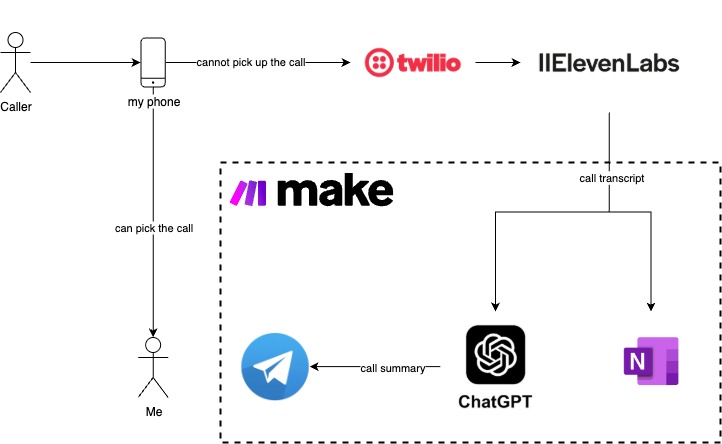
If I cannot pick up the call, it is redirected to a Twilio number, where ElevanLabs AI agents ask the caller for details. Next call transcript is sent to the orchestrator (make.com), which saves full transcript to OneNote and sends the call summary to Telegram.
Costs
Since June 2025 I had following costs:
1. Twilio – 6,5$
2. ElevenLabs – 25$
3. Make – 0$
4. Mobile telephone operator – 56$
Total: 87,5$
Usage
Since June 2025, I have received 70 calls to my personal AI assistant, but there was only one person, who actually had a conversation with my AI assistant, and it was my lovely wife 🙂 However, after a while she stopped talking to AI and reverted to sending me text messages when I didn’t pick up.
What I expected anyway? Almost nobody ever left me a message on a voicemail. Personally, I almost like never left message on voicemail. I would rather call again or send a text message.
Moreover, I’ve noticed that people don’t like talking to AI agents on the phone. Nowadays when you need support from a helpline, you’re first connected with an AI assistant. These assistants are far from perfect and in my experience they never actually help. I always need to talk to living human anyway, which makes whole process just longer.
Summary
The idea of having a personal AI call assistant sounded good. However, in practice it appeared that nobody is using it, which makes total sense when you think about it. On the other hand, it was fun setting up whole thing together to make it work.
I think it’s the same experience people have in US when they use the Google feature that does the same. Almost noone wants to talk to the agent.
But there the main purpose is to filter out spam callers, so if they don’t want to talk to AI agents – the users are still happy 🙂
Uh, spam callers are getting even more iritating due to increased amount of those calls. They even started using AI to make spam calls.